
Response Playbooks
From a verdict to an action
SocTalk's AI triage pipeline exists to answer one question about an alert: is this real, and what should happen to the case. The agentic loop enriches the alert, gathers context, investigates, and reasons its way to a verdict, and the run ends on a disposition. The disposition is the final call, one of escalate to a human, auto-close as a false positive, or ask for more evidence. That decision is the product of the whole upstream pipeline, and it is where triage policies do their work, keeping the parts of triage that must be guaranteed deterministic and letting the model reason about the ambiguous rest.
A disposition on its own changes nothing in the outside world. It does not open a ticket, page the on-call, hand the case to a SOAR, or pull a compromised laptop off the network. A response playbook is the layer that acts on the disposition. It runs strictly after triage commits, it reads what triage produced, and it turns that into concrete steps.
What it reads is a single typed object called the disposition envelope. SocTalk assembles the envelope the moment the disposition becomes final, inside the same database transaction, and it carries everything a response might key on. That is the effective disposition, meaning the final call after the safety floor has had its say; the model's verdict and its confidence; the alert's severity; its rule groups and rule ids; the ATT&CK techniques and tactics it was mapped to; the entities and IOCs involved; and which safety-floor vetoes fired along the way. The envelope is the contract between triage and response, and it is also the exact payload a playbook hands to any system downstream of it.
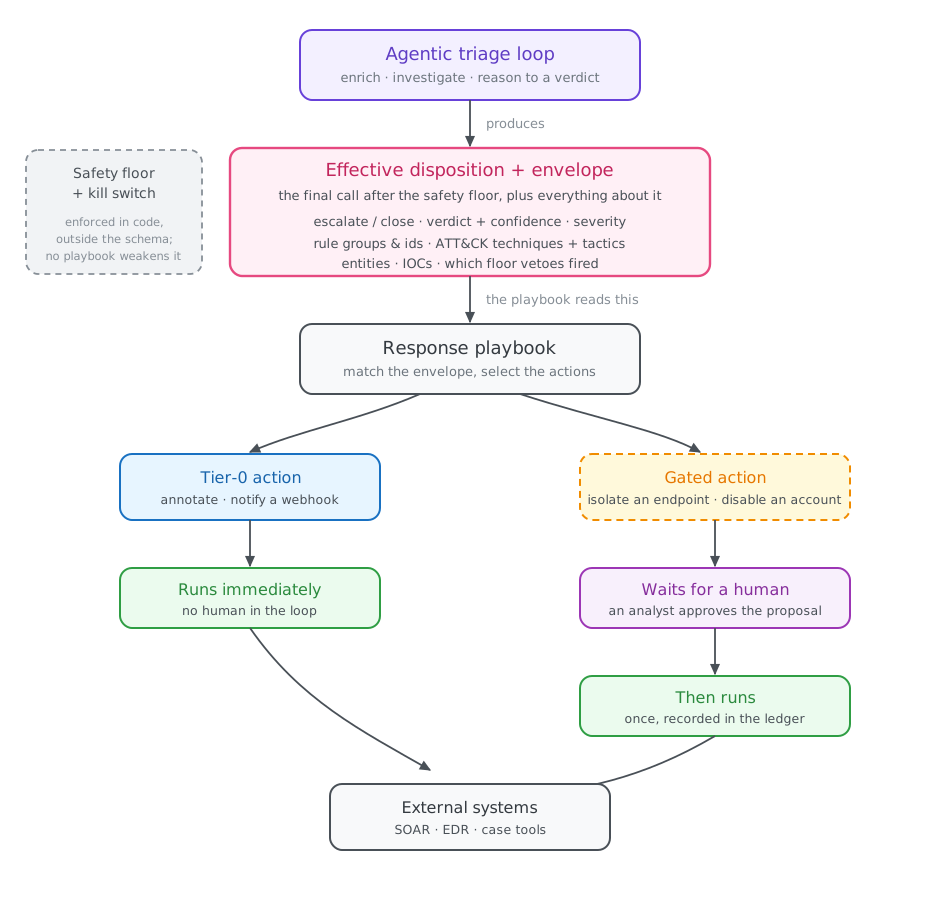
Everything below is the right-hand side of that picture: how a playbook matches the envelope, which actions it can take, and how the dangerous ones stay behind a human. The code lives in src/soctalk/response/.
What runs on its own, and what needs approval
Actions fall into two groups by how much they can affect your environment. Writing a note on the case or sending a notification to a webhook is safe to do on its own, because the worst it can do is add noise, so those run right away without anyone approving them. Isolating an endpoint or disabling an account is a different matter, so those never fire on their own. When a playbook calls for one, it does not run it. It raises a proposal on the case, and an analyst reviews and approves it before anything happens. The model never takes a containment action on its own during triage, and a playbook cannot take one on its own during response. In both cases a person signs off on anything that reaches into a live system.
Three rules live in code rather than in playbook data, and no playbook can weaken them. A close is the direction an attacker would most want to trigger, so on the close path a playbook may only annotate or audit, never take an external action. The dispatch kill switch, set with SOCTALK_RESPONSE_DISPATCH_KILL on the API process or the response_dispatch_kill flag on a tenant, stops every response with no rollout, which is the control to reach for when a connector starts misbehaving mid-incident. And a response fires only if the disposition actually took effect on the case. If an analyst closed or merged the investigation while the run was still going, nothing dispatches against a state that never happened.
The three capabilities
A playbook refers to a capability by name and can name nothing else. An unknown name is rejected when the playbook is validated. Three capabilities ship today.
annotate_investigation writes a system note on the case. It only touches SocTalk, it runs on its own, and it is the only action allowed on a close.
notify_webhook posts the signed envelope to the tenant's configured webhook. This is the handoff to an external SOAR. SocTalk signs the envelope and sends it, and the receiver owns everything that happens after. It also runs on its own.
external_action is the one that needs approval. It sends a named action together with the signed envelope to an endpoint the operator configured, and this is where the real work, isolating an endpoint or disabling an account, lives outside SocTalk behind a stable contract. It never runs without an analyst approving it first.
One detail keeps external_action safe. A playbook author names an endpoint and an action, never a URL. The operator maps that endpoint name to a real URL and a signing secret in the response_action_endpoints tenant policy, so an author can ask to isolate on the edr endpoint but cannot choose where the request actually goes. Every request is HMAC-signed, and it refuses to reach a private or link-local address.
The schema
A response playbook is data, and one interpreter runs any number of them. The playbook that the tutorial below builds looks like this:
id: isolate-lateral-movement-endpoint
version: 1
tenant: acme                       # a tenant slug or id; authored playbooks are always scoped
status: shadow                     # active or shadow
priority: 100                      # lower wins on a multi-match
applies_to:
  rule_groups: [sudo, su]
  mitre_techniques: [T1021]        # ATT&CK technique ids (Txxxx), not names
  mitre_tactics: ["Lateral Movement"]   # tactic strings as your source emits them
response:
  on_escalate:
    - capability: external_action
      when: { ">=": [{ "var": "severity" }, 10] }
      params: { endpoint: edr, action: isolate_endpoint }
    - capability: notify_webhook
    - capability: annotate_investigation
      params: { body: "endpoint isolation proposed for lateral-movement alert" }
  on_close:
    - capability: annotate_investigation
      params: { body: "auto-closed as false positive" }
The applies_to block decides which alerts the playbook owns. It matches on rule groups, rule ids, ATT&CK technique ids, or ATT&CK tactics, and the four are OR'd together, so any one of them hitting is a match. An empty applies_to matches every alert, which is fine, because the disposition lists already decide when a playbook actually fires. ATT&CK matching follows one rule. Techniques are matched by their canonical id such as T1021, never by name, because the human-readable names are unstable. Tactics are matched by whatever string the alert source emits, and Wazuh sends names like Lateral Movement rather than TA refs.
Under response, on_escalate holds up to eight actions to take when the case escalates, and on_close holds up to four annotation-tier actions for an auto-close. Each action is a capability name, an optional when condition, and a bag of params that the capability reads. The params are pass-through. external_action pulls endpoint and action out of them and forwards the rest, and it does not need the target host named in params, because the full signed envelope travels with every request and the entities ride inside it.
Conditions
A when condition is the only logic an author writes, and it runs in the same small sandboxed language as triage guardrails. It is a tree of single-operator nodes over a fixed set of fields, with no attribute access, no function calls, and no way to name anything outside the contract. The operators are var, the comparisons ==, !=, <, <=, >, and >=, the logical and, or, !, and !!, and in. An action fires only when its condition holds, and a condition over data that is absent is simply false rather than an error.
The fields a condition may read all come from the envelope. There is the effective disposition and the worker_disposition the model proposed before the floor changed it; floor_vetoed, which says whether a floor veto altered the outcome; verdict_confidence and severity; the alert's rule.groups and rule.ids; and the ATT&CK fields, mitre.techniques holding the canonical Txxxx ids and mitre.tactics holding the source's tactic strings. The last four are lists, so you test them with in. Writing {"in": ["T1021", {"var": "mitre.techniques"}]} fires the action when the alert carries technique T1021. Referencing a field or operator that the contract does not declare rejects the playbook when it is saved, well before it could ever run.
Build one in the no-code editor
Admins author response playbooks from the Response Playbooks page while a tenant is pinned, with no YAML required. This walks through building the isolate-lateral-movement-endpoint playbook from the schema above, end to end. It proposes isolating an endpoint on a high-severity lateral-movement escalation, notifies the SOC, and annotates the case.
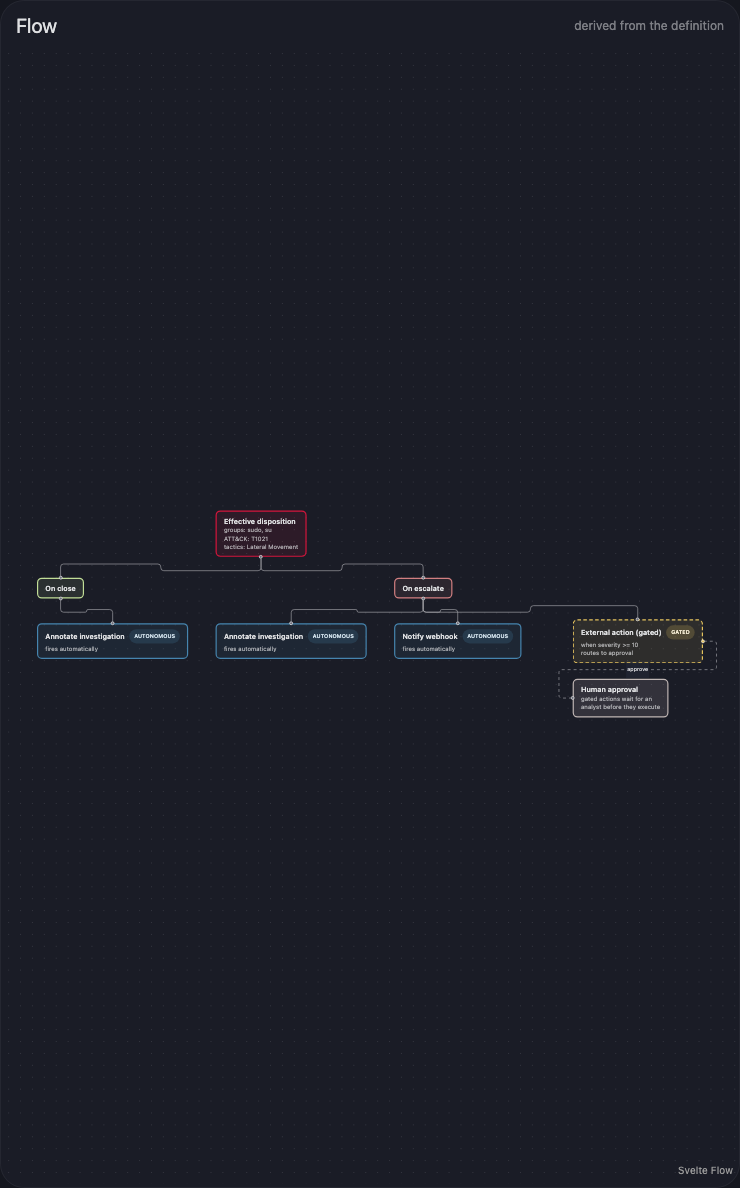
Open "+ New response playbook" (or navigate to /response-playbooks/editor). The editor is two columns. The document form is on the left, and a live flow diagram is on the right that re-renders on every edit, showing the disposition fanning out to the actions, with the ones that need approval routing through an approval step first.
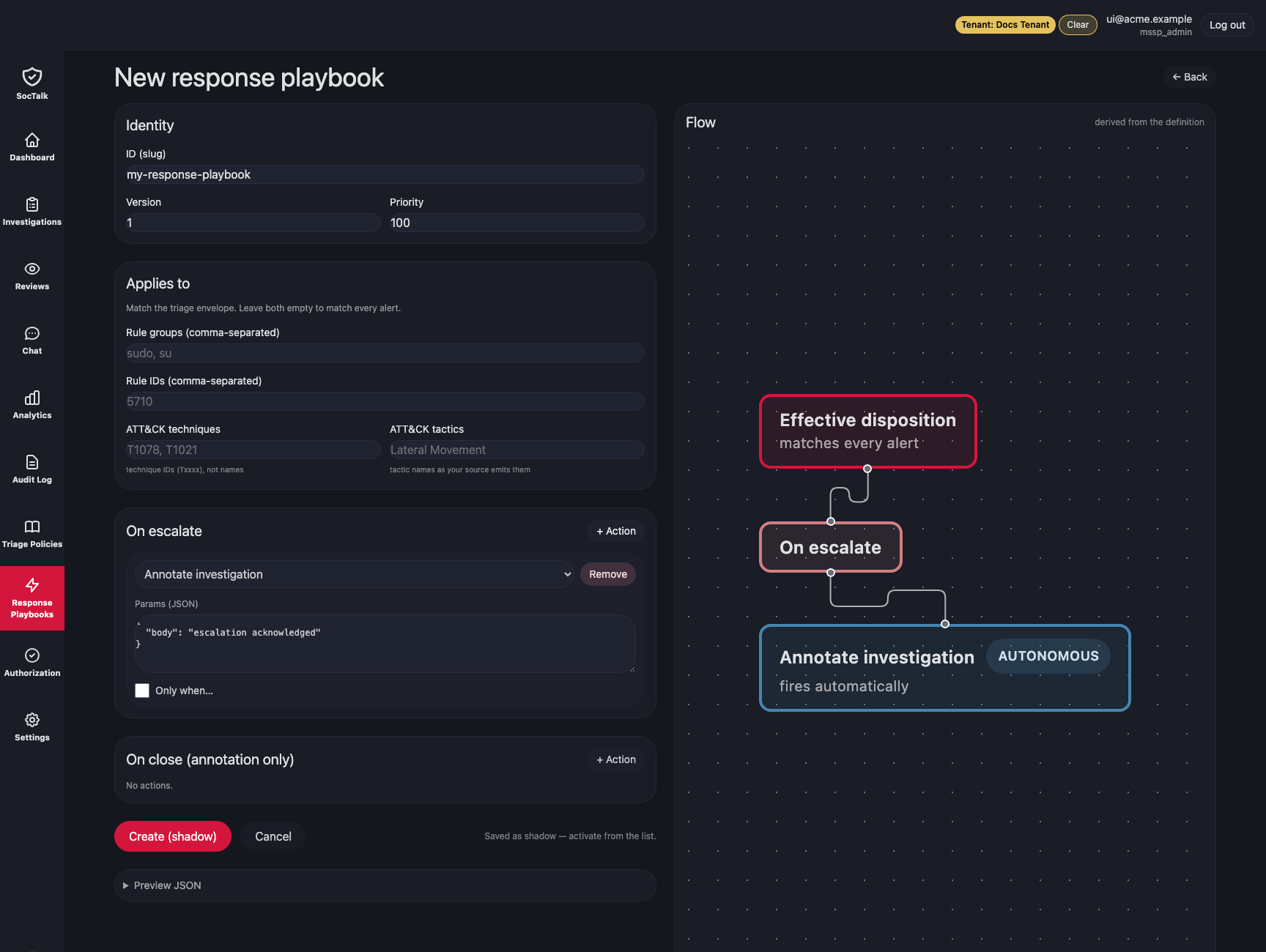
Start with identity. Give the playbook a slug id and a priority, where a lower number wins on a multi-match.
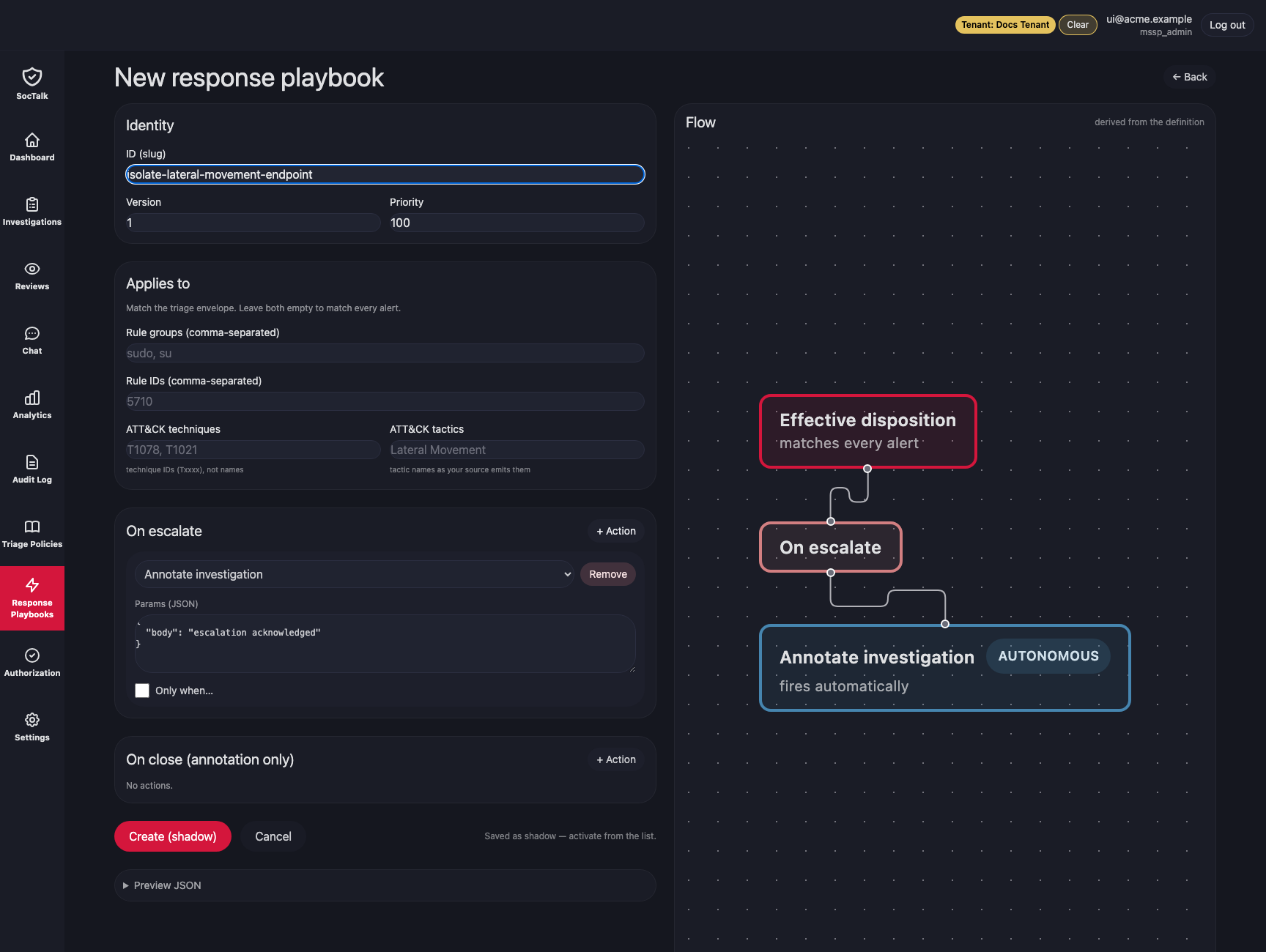
Next, decide which alerts it owns. The four matchers are OR'd. This playbook owns rule groups sudo and su and, more usefully, ATT&CK technique T1021 (Remote Services) and the tactic Lateral Movement, so it fires on any alert mapped to lateral movement, whichever rule raised it. The technique field takes ids, not names, and the tactic field takes the string your source emits.
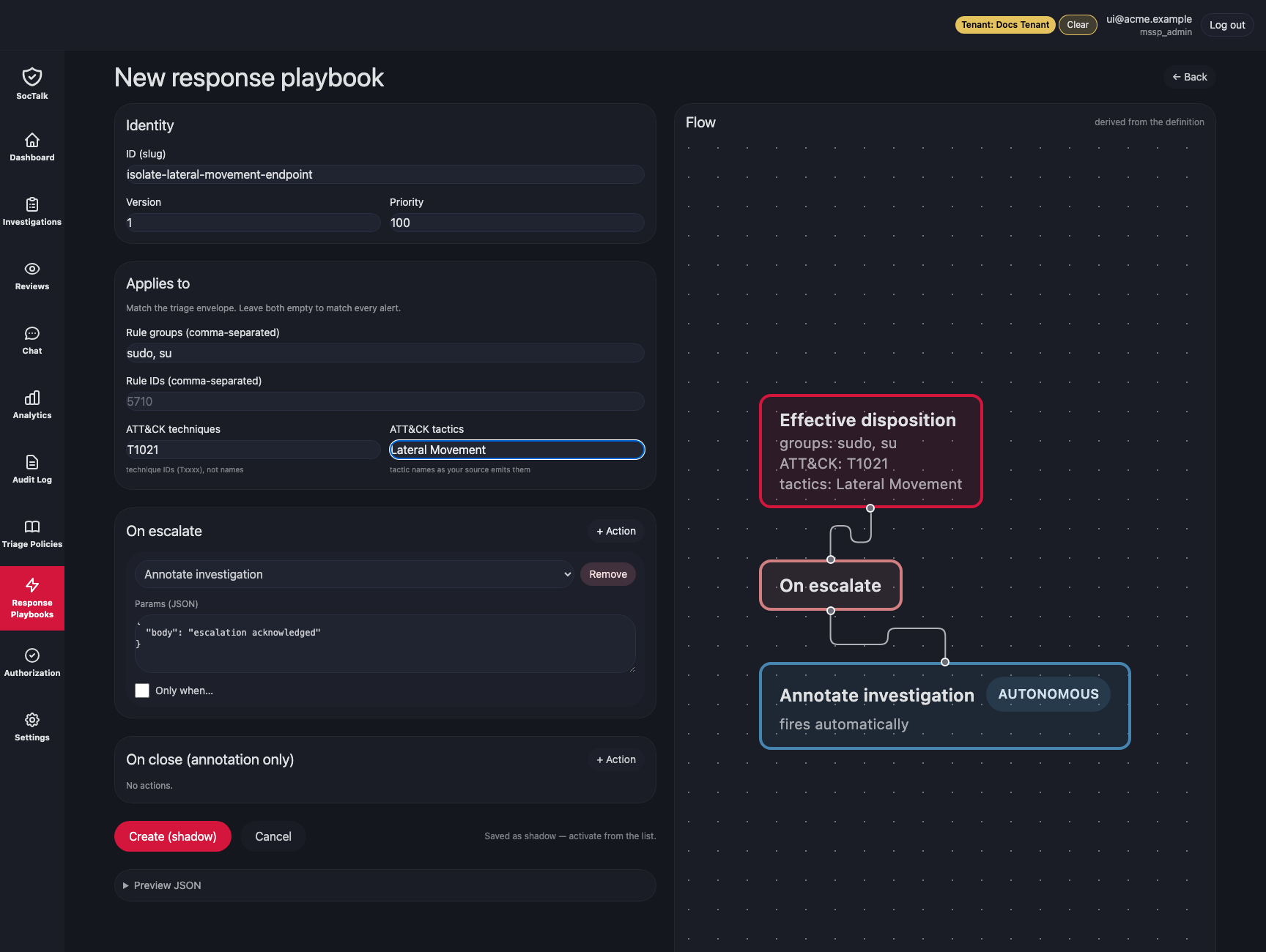
Now the isolation action. On escalate, add external_action, the one marked "needs approval." Name the endpoint the operator configured and the action, which is isolate_endpoint, in its params, and you never enter a URL. Add a condition so it only fires on a high-severity escalation.
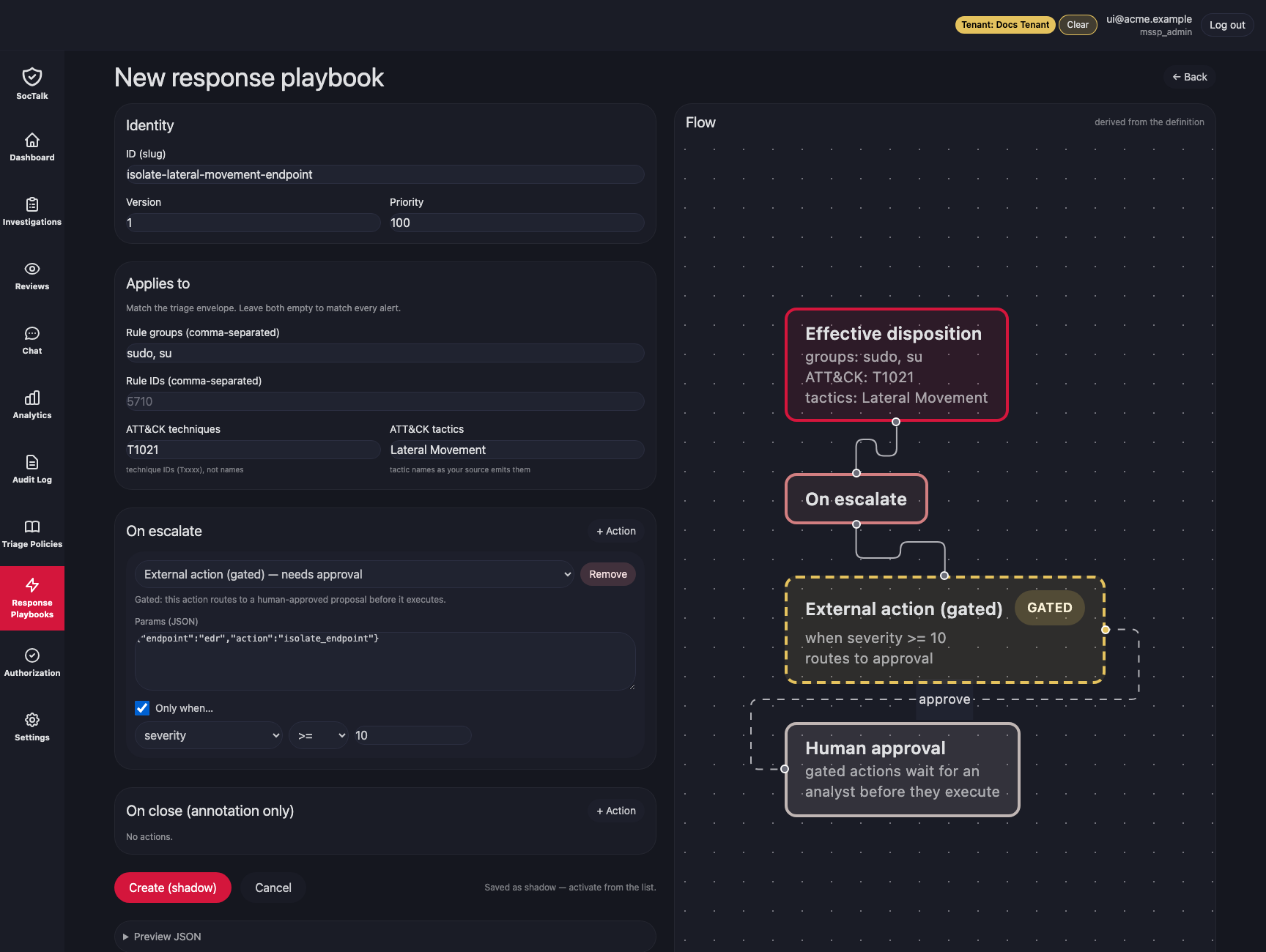
Add the two actions that round out the response and run on their own. A notify_webhook hands the case to the SOC's SOAR, and an annotate_investigation leaves an audit trail.
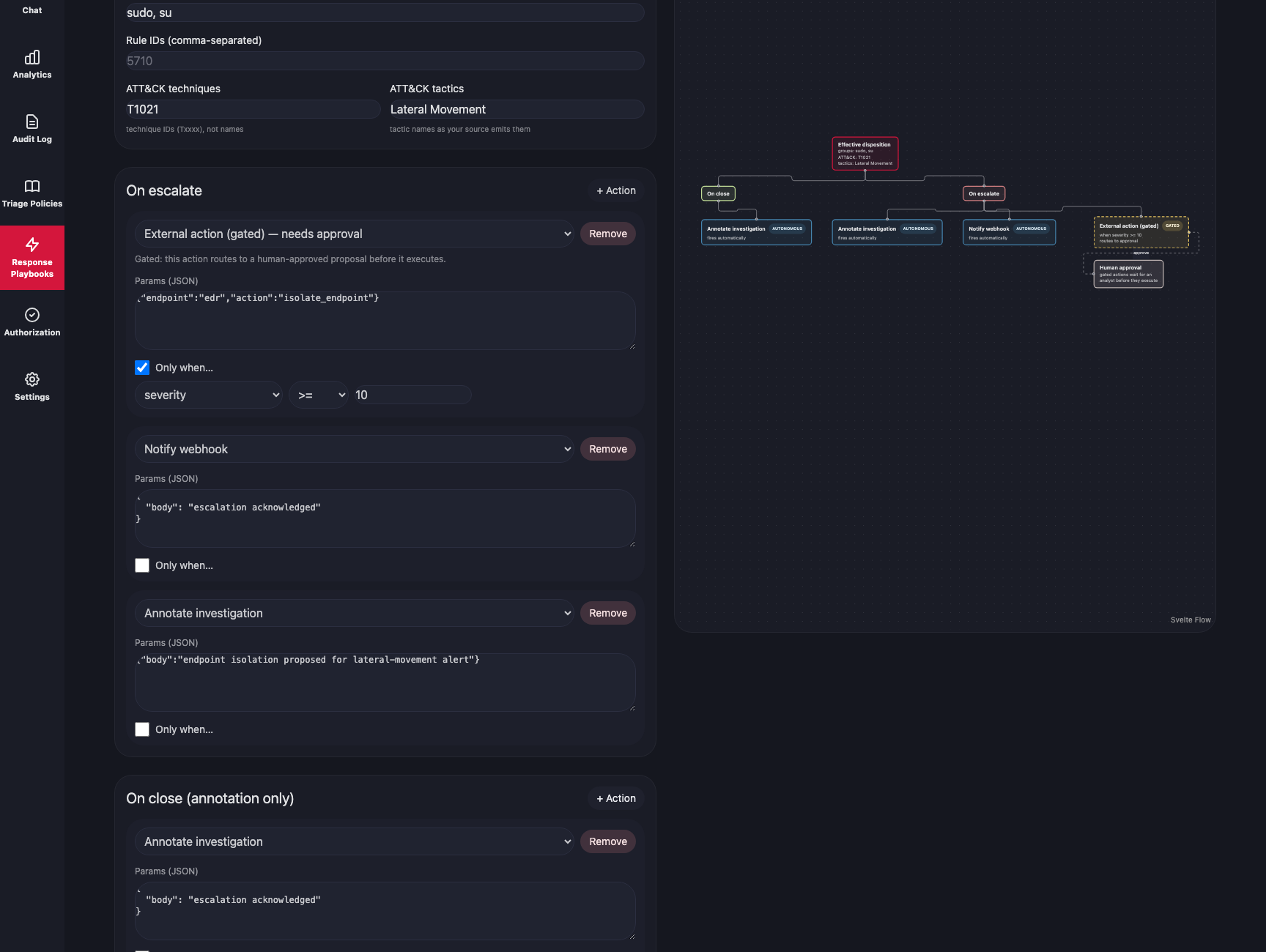
Read the flow while you build. The right column projects the whole document. The disposition envelope fans out to each action, the isolation action routes through an approval step before it can run, and the other two are shown running on their own.
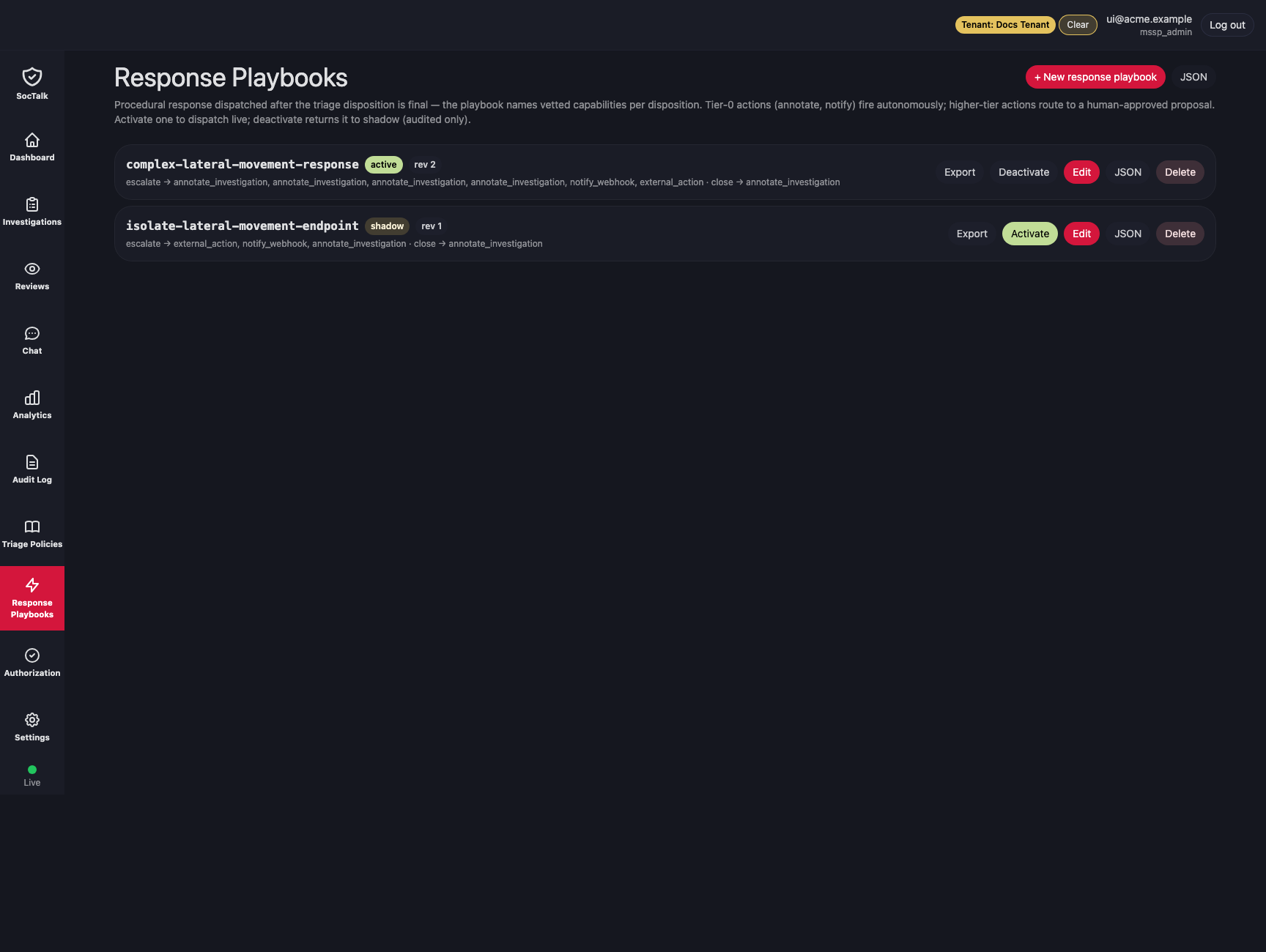
Saving with Create (shadow) persists it. The form and the stored document are the same artifact, and "Preview JSON" shows exactly what gets saved. Validation on save is fail-closed. The id must be a slug, every capability must be one of the vetted names, on_close may only annotate, and conditions must reference the declared contract. An unknown reference is rejected while you are authoring, never silently dropped at runtime.
Shadow, then activate
An authored playbook moves through four statuses: draft, shadow, active, and retired.
In shadow, the playbook is matched and its actions are selected exactly as an active one would be, and its would-fire actions are written to the audit trail, but nothing is enqueued. This gives you real evidence of what it would do against live traffic before it does anything.
Activating it, with the Activate action on the Response Playbooks page, turns it on, and unlike a triage policy it takes effect live. SocTalk evaluates response playbooks as each case is decided, so an active playbook applies to the very next disposition with no rollout to wait for. Deactivating returns it to shadow at once.
When an action that needs approval comes up on a real escalation, it lands as a proposal on the case. The analyst sees exactly what would run and against which host, and approving it is what triggers the isolation. The action runs once, the response it got back is recorded, and a repeated delivery never runs it twice.
The wiring
A few pieces carry all of this. SOCTALK_RESPONSE_PLAYBOOK_DIR on the API process is a directory of YAML playbooks loaded at startup, which is the git-managed path for operators who prefer playbooks as code. Playbooks authored in the UI live in the database instead, kept as an append-only history and scoped so a tenant only ever sees its own, and SocTalk merges them with the file playbooks so that a tenant's own playbook overrides a file one of the same id. response_webhook_url, with an optional response_webhook_secret, sets the notify_webhook target on a tenant. And response_action_endpoints on a tenant maps endpoint names to their url and secret for external_action, which is how the operator keeps control of the targets while a playbook only ever names one.
Every match, approval, action, and rejection is logged, and every action that runs records the playbook id and version along with the response it got back. A playbook that fails validation is rejected whole and never takes effect, so a bad edit ends up as "that playbook is not active" rather than a wrong action.