
Install
For MSSP cluster admins. Covers cluster prerequisites, the soctalk-system chart install, and onboarding the first customer.
Trying it for the first time? Use the demo VM instead. It's a single-image install with a browser-based wizard, much faster path to a running system. This page is the production path: K3s + Cilium + cert-manager + your own ingress controller.
Evaluating with 1-3 tenants? Launchpad automates the multi-tenant pilot end-to-end (VMs + Tailscale + this installer + tenant onboard). Come back here when you're building the real thing.
Quick install on a cloud Ubuntu VM (one-command)
For a single-node MSSP control plane on a bare Ubuntu 24.04 VM (cloud or on-prem), the same install.sh the demo VM bakes in is reachable as a one-command installer. It bootstraps k3s + Helm, pulls the soctalk-system OCI chart from GHCR, and seeds the admin / LLM secrets in one step.
Set the install config via env (any subset; the rest is prompted), when all three of SOCTALK_MSSP_NAME, SOCTALK_ADMIN_EMAIL, SOCTALK_ADMIN_PASSWORD are present the installer skips its consent prompt so unattended curl | bash flows work without -y:
export SOCTALK_MSSP_NAME="Acme MSSP"
export SOCTALK_ADMIN_EMAIL="admin@acme.example"
export SOCTALK_ADMIN_PASSWORD="$(openssl rand -base64 24)"
export SOCTALK_HOSTNAME="soctalk.acme.example"      # what the dashboard URL will be
export SOCTALK_LLM_PROVIDER="anthropic"             # or openai-compatible
export SOCTALK_LLM_API_KEY="sk-..."                 # OR --llm-key-file <path>

curl -sfL https://raw.githubusercontent.com/soctalk/soctalk/main/install.sh | bash
Flags worth knowing about: --yes / -y (assume-yes when env is partial), --demo (random admin password + auto-onboards a demo tenant, fastest "just show me" path; no env required), --chart-version <v> (pin a specific chart release), --chart-dir <path> / --values-file <path> (offline / air-gapped). Full reference: install.sh --help.
The script propagates SOCTALK_HOSTNAME into the chart's ingress.hostnames.mssp and the chart in turn derives SOCTALK_PUBLIC_ORIGIN (CSRF) and SOCTALK_L1_PUBLIC_URL (the URL the tenant cloud-agent uses for /register). No manual env-var fiddling on the api Deployment required.
If you need finer control, non-default ingress controller, separate customer hostname, cert-manager ClusterIssuer, etc., use the Helm path below instead.
Cluster prerequisites
Install these once per K3s cluster before soctalk-system. SocTalk expects Kubernetes 1.30+ because the system chart installs a native ValidatingAdmissionPolicy guard for tenant namespace operations.
K3s with Cilium
# Production K3s: disable flannel + kube-proxy + traefik so Cilium (CNI)
# and your chosen ingress controller take over. The demo VM image uses
# the *bundled* Traefik instead — that's intentional for a zero-config
# single-box install but not what you want for production.
curl -sfL https://get.k3s.io | INSTALL_K3S_EXEC=" \
  --flannel-backend=none \
  --disable-network-policy \
  --disable-kube-proxy \
  --disable=traefik \
" sh -

# Install Cilium.
helm repo add cilium https://helm.cilium.io/
helm install cilium cilium/cilium --version 1.15.x \
  --namespace kube-system \
  --set kubeProxyReplacement=true \
  --set k8sServiceHost=<node-ip> \
  --set k8sServicePort=6443 \
  --set hubble.relay.enabled=true \
  --set hubble.ui.enabled=true

# Verify.
cilium status
cert-manager
helm repo add jetstack https://charts.jetstack.io
helm install cert-manager jetstack/cert-manager \
  --namespace cert-manager --create-namespace \
  --version v1.14.x \
  --set installCRDs=true
Configure a ClusterIssuer appropriate for your environment (Let's Encrypt, internal CA, or self-signed for dev).
The default SocTalk values request a wildcard host for customer UIs (*.customers.your-mssp.example), and Let's Encrypt only issues wildcards over DNS-01. Use a DNS-01 solver with the provider that hosts your zone. Example for Cloudflare:
apiVersion: cert-manager.io/v1
kind: ClusterIssuer
metadata: { name: letsencrypt-prod }
spec:
  acme:
    server: https://acme-v02.api.letsencrypt.org/directory
    email: ops@your-mssp.example
    privateKeySecretRef: { name: letsencrypt-prod }
    solvers:
      - selector:
          dnsZones:
            - your-mssp.example
        dns01:
          cloudflare:
            email: ops@your-mssp.example
            apiTokenSecretRef:
              name: cloudflare-api-token
              key: api-token
cert-manager has solver recipes for Route 53, Cloud DNS, Azure DNS, RFC 2136, and others. Pick the one for your zone provider.
If you do not need wildcard customer hostnames (i.e., you enumerate customer hosts individually), you can use HTTP-01 with
solvers: [- http01: { ingress: { class: traefik } }]instead. Thesoctalk-systemvalues default toclassName: traefik; the ACME solver'singress.class(HTTP-01) or DNS provider must match the chart's ingress class. For ingress-nginx, setclass: nginxon both sides.
Ingress controller
K3s does not ship Traefik with us (we disabled it above). Install your preferred ingress:
# Option A: Traefik v3
helm repo add traefik https://traefik.github.io/charts
helm install traefik traefik/traefik -n ingress-system --create-namespace

# Option B: ingress-nginx
helm repo add ingress-nginx https://kubernetes.github.io/ingress-nginx
helm install ingress-nginx ingress-nginx/ingress-nginx -n ingress-system --create-namespace
Label the ingress namespace for NetworkPolicy:
kubectl label namespace ingress-system managed-by=ingressAuthentication mode
The API reads SOCTALK_AUTH_MODE (internal | proxy) at startup. The soctalk-system chart deploys in internal mode: SocTalk owns login, sessions, and password storage, and the bootstrap Job seeds an initial admin into a Secret (see Run the bootstrap).
proxy mode, front SocTalk with OAuth2-Proxy / Keycloak / Dex and trust upstream identity headers, is supported by the runtime but not yet exposed as a chart values knob. Treat it as a future-release item; if you operate central SSO and want to pilot it now, set the env var directly on the API Deployment after install.
Full details: Internal auth.
StorageClass
Any dynamic provisioner works. For K3s default, local-path is pre-installed. For production, use Longhorn, Rook/Ceph, or a cloud-provider CSI. Ensure one is marked storageclass.kubernetes.io/is-default-class=true.
Install SocTalk
Prepare values
Create soctalk-system-values.yaml:
install:
  msspId: "<uuid>"         # generate: uuidgen | tr A-Z a-z
  msspName: "Your MSSP"
  installId: "<uuid>"
  installLabel: "pilot-prod"

image:
  registry: ghcr.io/soctalk
  # omit image.tag: the chart already defaults to its own release,
  # so this cannot drift out of date. Set it only to pin something else.

ingress:
  enabled: true
  className: traefik          # chart default; set to "nginx" for ingress-nginx
  tls:
    issuerRef: letsencrypt-prod
    secretName: soctalk-tls
  hostnames:
    mssp: mssp.your-mssp.example
    customer: "*.customers.your-mssp.example"

# Auth knobs the chart accepts today. See the Authentication mode
# section above for proxy mode (not yet wired through values).
auth:
  cookieSecure: true          # production TLS: keep true; HTTP-only dev: false

# Trusted headers and proxy CIDRs are read by the API only in proxy
# mode (which today requires a manual env-var override after install).
# Defaults shown for reference; safe to omit when running internal mode.
oidc:
  trustedHeaderUser: X-Forwarded-User
  trustedHeaderEmail: X-Forwarded-Email
  trustedHeaderGroups: X-Forwarded-Groups
  trustedProxyCIDRs:
    - 10.42.0.0/16   # your pod CIDR / ingress CIDR

postgres:
  enabled: true
  storage: { size: 20Gi }

# Required if you want a working sign-in on first install. The chart's
# db-init container creates this user inline; without it, no admin
# exists and `soctalk-auth set-password` (which only updates existing
# users) has nothing to update.
install:
  bootstrapAdmin:
    email: "ops@your-mssp.example"
    password: "changeMe-please-rotate"   # rotate via `soctalk-auth set-password` after first sign-in
    displayName: "MSSP Admin"
    # Production alternative: leave password empty and set
    # existingSecret to a pre-provisioned Secret with key `password`
    # so the credential never passes through helm values.
    # existingSecret: "my-bootstrap-admin"
Install
helm install soctalk-system oci://ghcr.io/soctalk/charts/soctalk-system \
  --version 0.2.1 \
  --namespace soctalk-system --create-namespace \
  -f soctalk-system-values.yaml
The chart's pre-install Job verifies cluster prerequisites and fails fast if any are missing.
Migrations and bootstrap run automatically
Both happen inside the API pod's init command before the FastAPI app starts:
- Wait for Postgres to accept connections.
alembic upgrade headto migrate to the latest schema.- Bind per-role passwords (
soctalk_app,soctalk_mssp). - Seed the Organization row from
install.msspId/install.msspName. - If
install.bootstrapAdmin.emailandinstall.bootstrapAdmin.passwordare set in values, upsert the user asmssp_adminwithmust_change=falseand the supplied password.
So if you put the bootstrap admin credentials in values, the API comes up with the admin already created: no extra Job to run.
The chart does not ship a separate Alembic Job; the previous edition of this page described one that didn't exist. Migrations are tied to the API pod's lifecycle. Watching them:
kubectl -n soctalk-system logs deploy/soctalk-system-api -c db-init --followOn an upgrade, deleting the API pod re-runs the migration (alembic is idempotent, so re-running on an unchanged DB is a no-op).
If you did NOT supply install.bootstrapAdmin.password in values, set the admin password after install:
kubectl -n soctalk-system exec -it deploy/soctalk-system-api -- \
  soctalk-auth set-password <admin-email>
In proxy auth mode, password endpoints are not mounted. JIT user provisioning on first authenticated request is not implemented in V1: you must seed the first MSSP user manually (e.g., via kubectl exec on the API pod and direct SQL INSERT against the users table) before any proxy-authenticated request can succeed. A real JIT path is on the roadmap.
Verify the install
# All soctalk-system pods Ready
kubectl -n soctalk-system get pods
# No cross-tenant traffic (Hubble)
hubble observe --namespace soctalk-system
Sign in at https://mssp.your-mssp.example with the bootstrap admin. You should land on the MSSP dashboard:
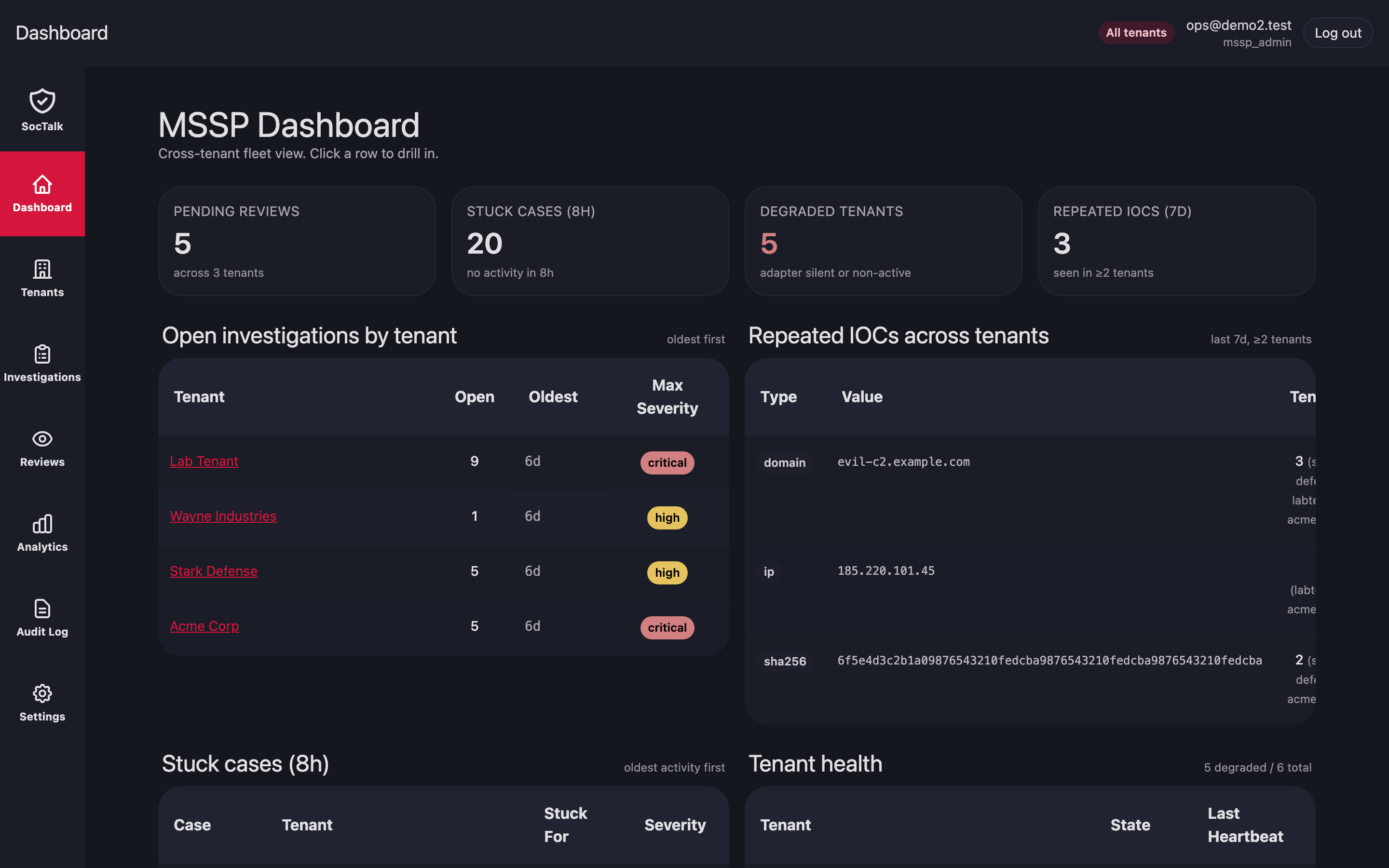
For a tour of every screen you'll see from here on, read the MSSP UI Tour.
Onboard the first customer
In the MSSP UI go to Tenants → New tenant. The onboarding form collects: slug, display name, profile (poc | persistent | provided), contact email, branding, and optional LLM base URL + model overrides. Customer-viewer invites are not in the form, that's configured after the tenant reaches active. Provisioning runs asynchronously; refresh the detail page to see new lifecycle events appear in the events table. (A live event stream is on the roadmap; /api/events/stream exists but emits pings only in this release.) If you pick provided (BYO Wazuh), the form additionally requires the external indexer + Manager API URLs and credentials plus a per-tenant LLM key, see tenant lifecycle / provided.
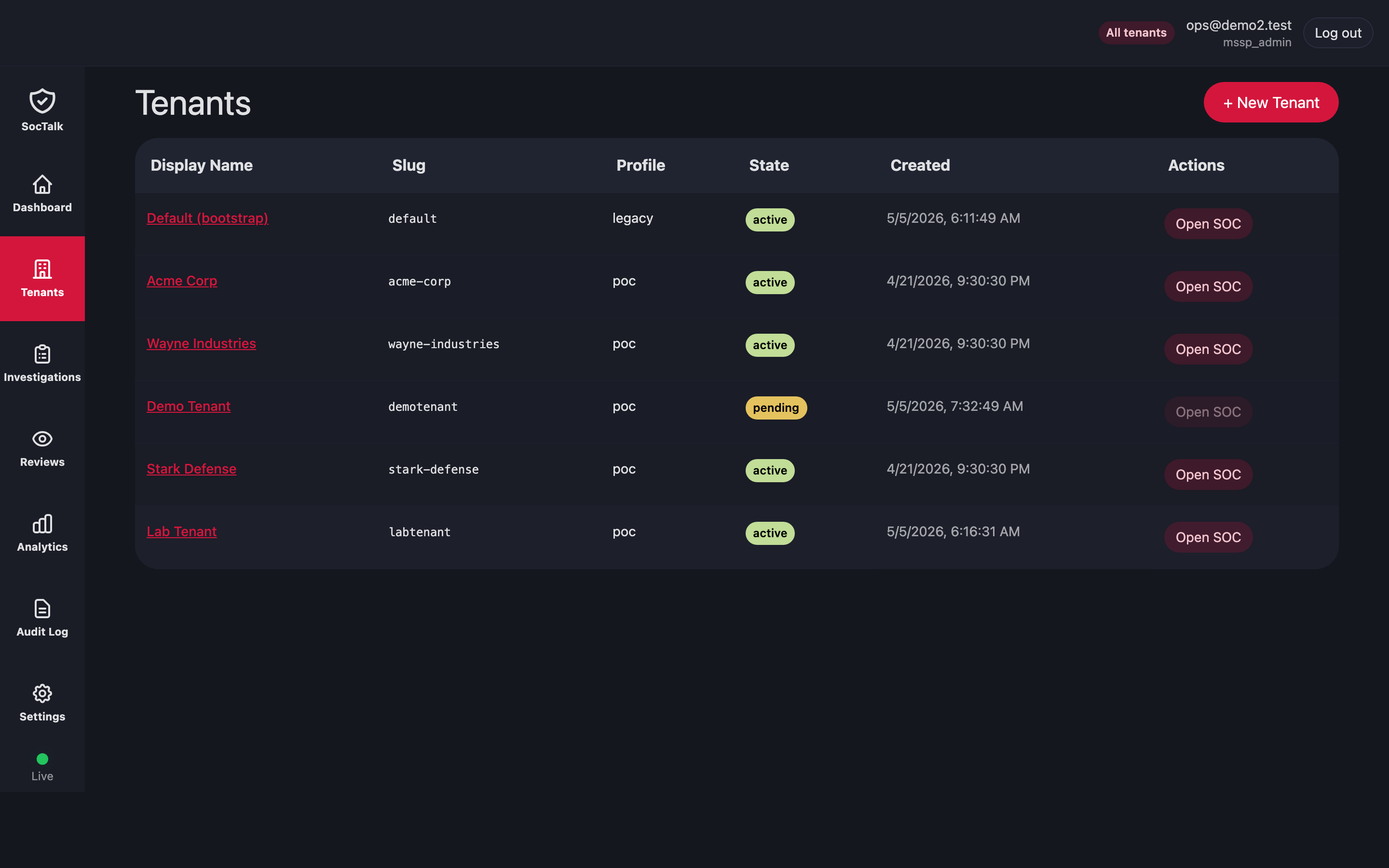
After the tenant reaches active:
- Update the tenant's LLM API key via Customer → Settings → LLM.
- Configure Wazuh agent ingress per Wazuh Ingress.
- Share the customer UI URL and initial
customer_viewerinvite with the end-customer.
Then verify:
# All soctalk-system pods Ready
kubectl -n soctalk-system get pods
# Tenant namespace exists and data plane is Ready
kubectl -n tenant-<slug> get pods
# No cross-tenant traffic (Hubble)
hubble observe --namespace tenant-<slug> --verdict DROPPED
Next
- Daily Operations for day-2 tasks.
- Upgrades for install-level and per-tenant upgrades.
- Wazuh Ingress for customer agent onboarding.