
Triage Policies
An LLM triaging a sudo alert is a brilliant analyst and a poor guarantee. Ask it the same question twice and you can get two answers. Tell it to always pull the change record before deciding and it will, usually, mostly. But some of triage isn't a judgment call. An evidence step has to run before a verdict counts. A close on a PCI asset must pause for a human. A flood of agent-health noise shouldn't cost a model call at all. For those, you don't want reasoning. You want a rule.
A triage policy is that rule, written as data. It doesn't replace the agent; it wraps a few deterministic gates around the agentic loop (the supervisor-and-tools cycle that enriches, investigates, and reasons its way to a verdict). Every one of them obeys the same law:
The LLM proposes. A deterministic gate disposes.
The model stays free to reason. A pure function decides whether its output takes effect, and it only ever steps in on edges you can prove: an authorization record that contradicts the activity, an IOC on the alert, an active incident that shares an entity with this one. The ambiguous middle passes straight through to the model, where it belongs.
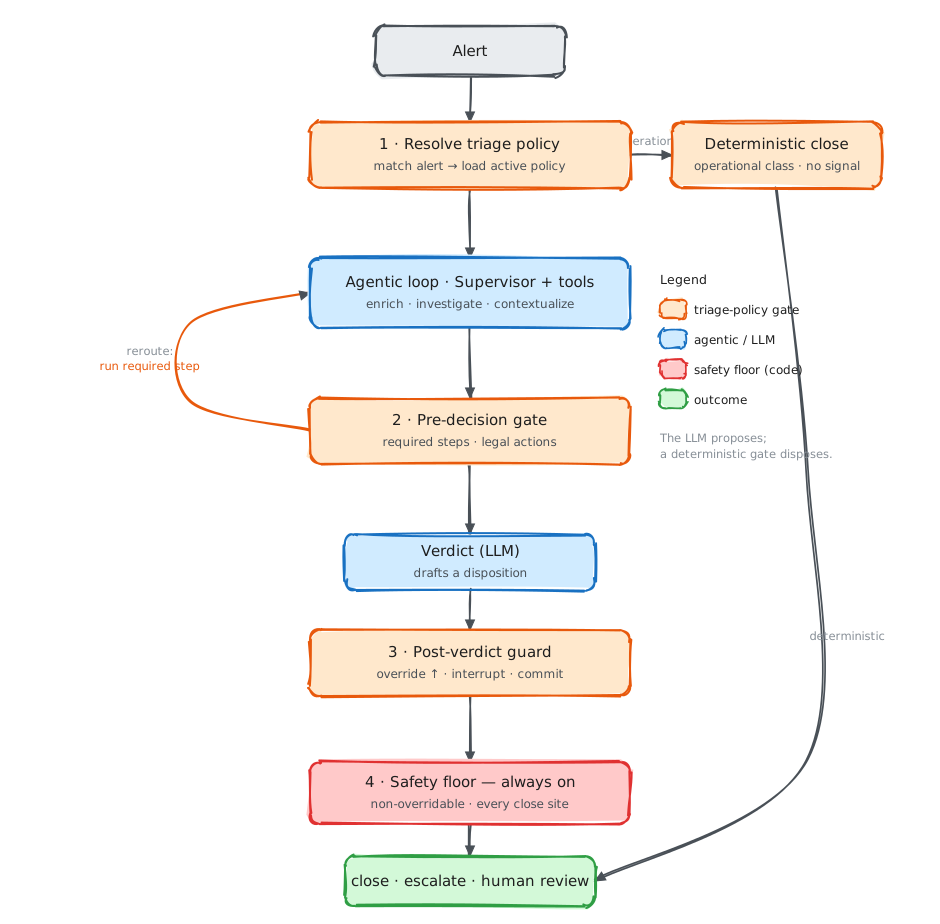
Read it top to bottom: an alert resolves against the registry, runs the agentic loop under the policy's gates, and lands on a disposition: the final call on the case (auto-close, escalate to a human, or ask for more evidence). Underneath every automatic close sits a safety floor: a set of non-overridable, code-level vetoes that no policy can weaken, defined in full below. The numbered gates are the whole surface, and the next section walks them one at a time.
The one property that makes all of this safe: a tenant-authored triage policy can make triage stricter, never looser; its guardrails only raise, and the hard floor beneath every close can't be weakened. (Vetted built-in and operator-managed file policies are trusted code and aren't bound by that constraint.) The code lives in src/soctalk/triage_policy/.
Where a triage policy acts
A triage policy governs one run at four points, the numbered gates in the diagram above.
- Resolver. An entry node matches the alert against the registry and writes the active triage policy into the run state. If the alert belongs to a known operational class with no security indicators, the run can close deterministically here without ever calling the model.
- Pre-decision gate. A policy can require deterministic steps (for example, gathering authorization context) before a verdict is legal. If the supervisor proposes a verdict too early, the gate reroutes it to the required step first. A policy can also restrict which supervisor actions are legal in each phase, and that restriction is applied to the model's structured output before the call, so an illegal action cannot even be sampled.
- Post-verdict guard. After the model drafts a verdict, a pure function decides whether it commits. It can override the draft (raise a close to an escalate), interrupt it (keep the draft but route to human sign-off), or let it stand. Every override is recorded.
- Safety floor. A non-overridable set of checks guards every automatic-close path. It is not a single step; the IOC/authorization vetoes run inside the post-verdict guard, and the kill-switch, volume-cap, and active-incident vetoes run again when a close commits on the worker, server, and ingest planes. The diagram draws it as one node for clarity; nothing in a triage policy can weaken it wherever it runs.
The safety floor
The floor is enforced in code, not in policy data, and it applies on every plane where a case can close automatically: the worker's disposition, the server that commits it, and the ingest fast-paths (memoized close and rules-based auto-close). A close is vetoed and the case is promoted or escalated instead when any of these hold:
| Veto | When it fires |
|---|---|
| IOC present | On the verdict path, a malicious enrichment verdict or a MISP match; on the ingest fast-paths, any raw IOC on the alert. |
| Contradicted authorization | Records exist but do not cover the activity (expired, out of window, wrong scope, forbidden by policy). |
| Unverified IOC | A router-tier close with observables that no enrichment ever checked. |
| Active incident | Another active investigation shares an attach-eligible entity with this one. |
| Kill switch | Auto-close is turned off, per tenant or install-wide. |
| Volume cap | The tenant's rolling count of automatic closes is spent. |
The effective set of gates on any run is the floor plus whatever the active policy adds. A triage policy can only make things stricter. This is what makes tenant-authored policies safe to allow: a misconfigured or hostile one cannot become a channel for suppressing detections.
The kill switch and volume cap are worth knowing by name. SOCTALK_AUTO_CLOSE_KILL on the API process, or the auto_close_kill policy flag on a tenant, flips every automatic close to a promotion with no rollout needed, which is the control you reach for mid-incident. auto_close_volume_cap (default 500 per 24 hours) means a runaway close loop degrades to "humans look at these" rather than mass suppression.
Built-in triage policies
Two ship with the product. Both are vetted code and read-only.
dual-use-privileged-exec handles host-auth activity like sudo and su, where the same event is routine administration under a covering change record and an incident without one. It requires the gather_authorization_context step before any verdict, removes CLOSE from the supervisor's legal actions (so the cheap router tier cannot short-circuit a case whose whole point is that benign and hostile look identical), and requires human sign-off on any close touching a PCI-classified asset.
agent-health-operational handles Wazuh agent self-monitoring noise, such as rule 202 "Agent event queue is flooded." This is an infrastructure condition, not a security event, so the policy closes it deterministically with no model call at all, which also makes the outcome consistent instead of varying run to run. Any security indicator on the alert (a MITRE technique, an IOC, a malicious signal, an unattested class, or a critical Wazuh level (12+)) vetoes the deterministic close and sends the alert to full triage.
You can see both, with every gate and guardrail expanded, on the Triage Policies page in the MSSP dashboard.
The schema
A triage policy is data. One generic interpreter runs any number of them.
id: regulated-privileged-exec
version: 2
tenant: acme                       # a tenant slug or id; authored policies are always scoped
status: shadow                     # active | shadow
priority: 70                       # lower wins on a multi-match; authored/file >= 60
applies_to:
  rule_groups: [sudo]
  rule_ids: []
  authorization_tracks: [account]
required_steps: [gather_authorization_context]
decision_modules: [authorization_engine]
legal_actions:
  decide:  [VERDICT]               # an unlisted phase is unconstrained
close_signoff_data_classes: [pci]
guardrails:
  - when:
      "and":
        - "==": [{ "var": "authz.class" }, "contradicted"]
        - "==": [{ "var": "verdict" }, "close"]
    effect: override
    to: escalate
    reason: acted outside the terms of an authorization
Read that condition as: if the authorization class came out contradicted and the model drafted a close, raise it to escalate. Each node is a single operator over its arguments, and var reads a field from the state contract.
| Field | Meaning |
|---|---|
applies_to | Which alerts the policy governs. Matched on rule groups, rule ids, or the authorization track of the alert's activity; the three are OR'd. |
required_steps | Deterministic nodes that must run before a verdict is legal. |
decision_modules | Declares the vetted engines the policy relies on (today: authorization_engine), validated against known modules. The runtime consultation is currently driven by required_steps (e.g. gather_authorization_context), not by this field. |
legal_actions | The supervisor actions allowed per phase (triage until the required steps have run, then decide). An unlisted phase is unconstrained. |
close_signoff_data_classes | A committing close on an asset in one of these classes is interrupted for human sign-off. |
guardrails | Declarative override or interrupt rules. See below. |
priority | Registry order. Built-ins occupy 10 and 50; anything authored or file-loaded must be 60 or higher, so it can never outrank a built-in's protections. |
Some capabilities are constrained by where a policy comes from:
- Deterministic dispositions (the thing
agent-health-operationaluses to close without a model) are built-in-only: minting a new auto-close class is a code-review decision, not configuration. - Authored policies may not grant
CLOSEinlegal_actions. Granting it adds nothing over an unconstrained phase (the baseline already permits the router close) but would let the illegal-action remap force every proposal to a verdict-less auto-close standing only on the coarse floor. Terminal decisions route throughVERDICTinstead; validation rejectsCLOSEin any phase. Built-in and file policies may still list the full action set.
Guardrail conditions
Conditions are the only logic an author writes, and they run in a small sandboxed language over a documented state contract. There is no attribute access, no function calls, no way to name anything outside the contract. A condition is a tree of single-operator nodes.
Operators: var, the comparisons (==, !=, <, <=, >, >=), the logical and / or / ! / !!, and in.
The fields a condition may read:
| Field | What it is |
|---|---|
authz.class | covered, contradicted, or absent, derived from the engine. |
authz.in_scope, authz.sanctioned_or_routine, authz.actor_genuine, authz.policy_allowed | The four expectedness components: the authorization engine's booleans for whether the activity fell in an approved scope, was sanctioned or routine, was performed by a genuine actor, and was permitted by policy. |
verdict | The model's draft decision. |
verdict_confidence | Its confidence, 0.0 to 1.0. |
asset.data_classification, asset.environment, asset.criticality | Trust-resolved attributes of the activity's asset. |
enrichment.ioc | Whether a malicious signal is present. |
correlation.active_incident | Whether an active incident overlaps. |
An effect is either override or interrupt. Suppression is not expressible: close is not a valid target, and an override may only raise a decision up the ladder close < needs_more_info < escalate, never down it. A condition that references an undeclared field or an unknown operator is rejected when the policy is validated, before it can ever run. Note that enrichment.ioc and correlation.active_incident are also enforced by the hard floor independently of any guardrail; in a shipped worker run correlation.active_incident is usually only populated at the commit-time floor, so lean on the floor for those rather than re-deriving them in a guardrail.
Author one in the no-code editor
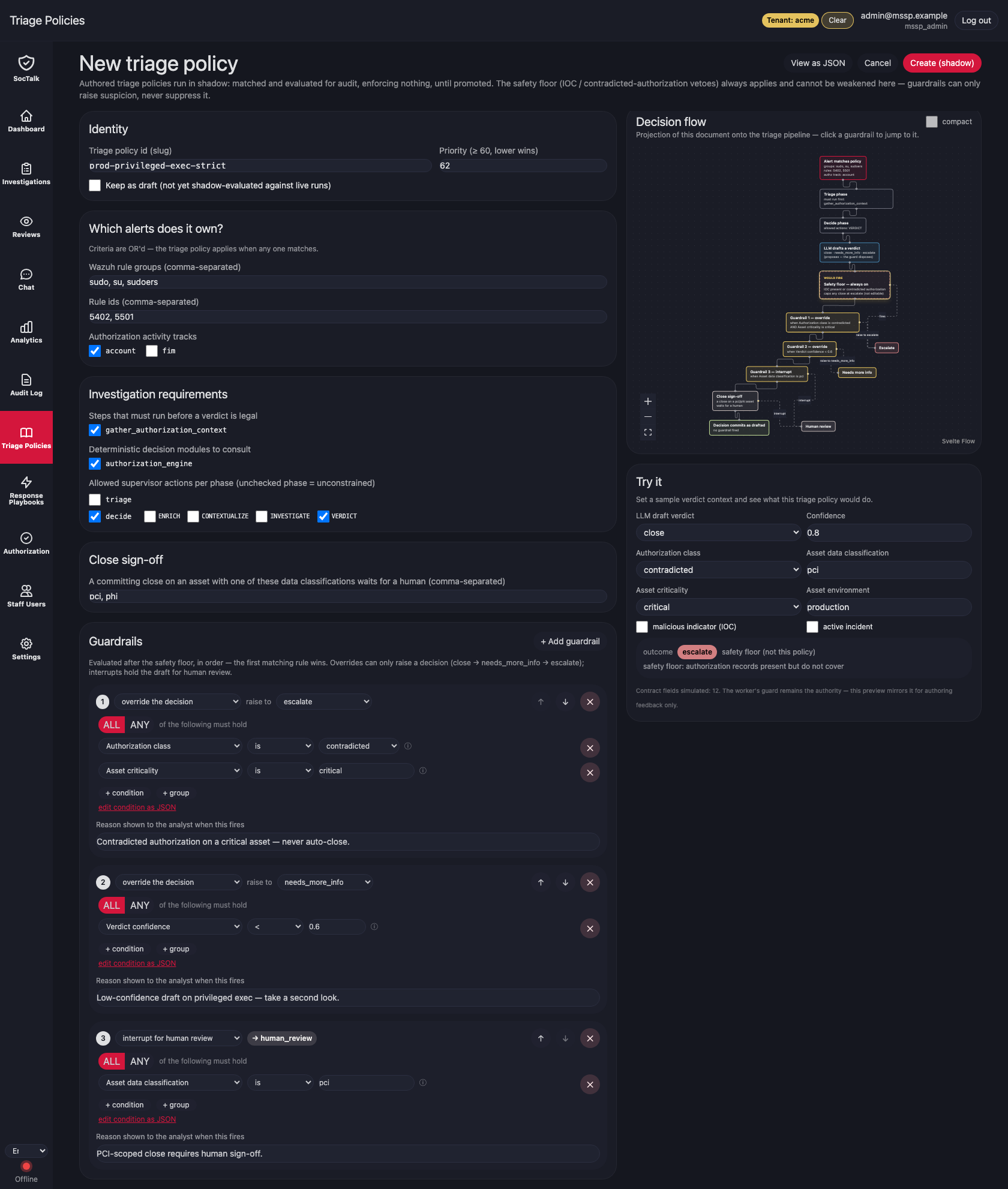
Admins author triage policies from the Triage Policies page while a tenant is pinned, no YAML required. This walks through building one real, non-trivial policy end to end. The example, prod-privileged-exec-strict, governs privileged-execution alerts on an account-authorization track: it demands authorization evidence, narrows what the agent may do, and adds raise-only guardrails plus a PCI close gate.
Open “+ New triage policy” (or /triage-policies/editor). The editor is two columns, the document form on the left, and a live decision-flow projection plus a “Try it” simulator on the right that re-render on every edit.
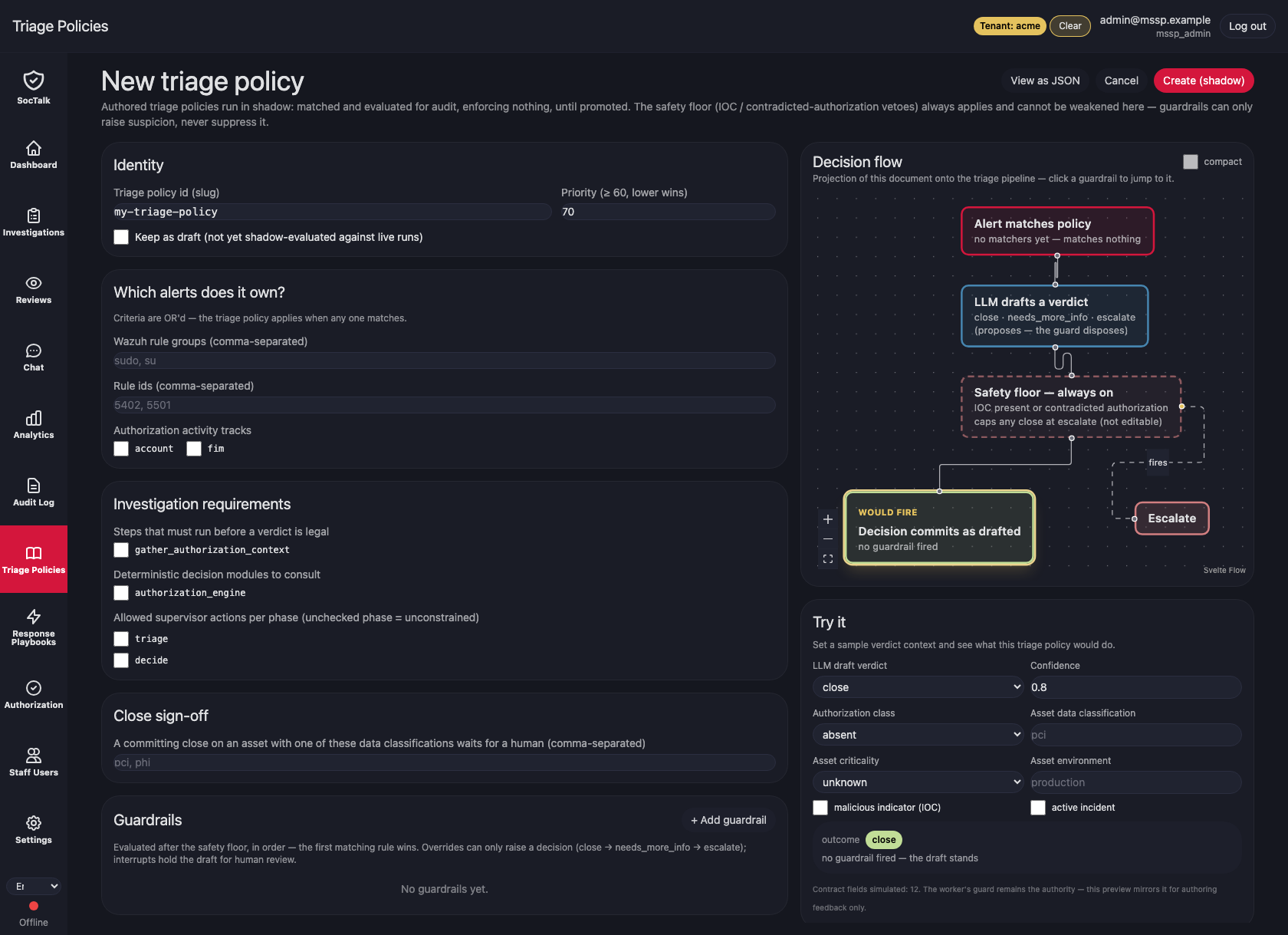
1. Identity. Give the policy a slug id and a priority: a floor-gated integer (≥ 60) where lower wins on a double match, so an authored policy can never outrank the built-in protections.

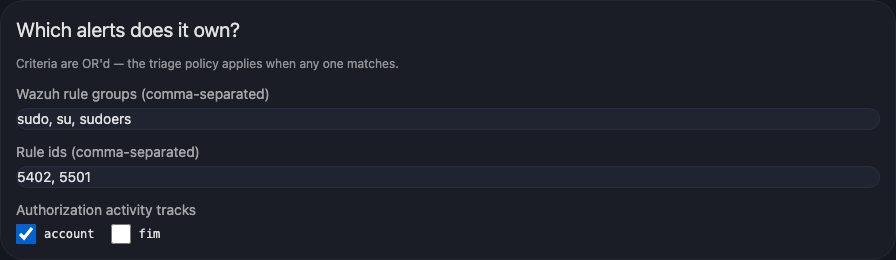
2. Which alerts does it own? The three matchers are OR'd. Here the policy owns rule groups sudo, su, sudoers, rule ids 5402, 5501, on the account track.
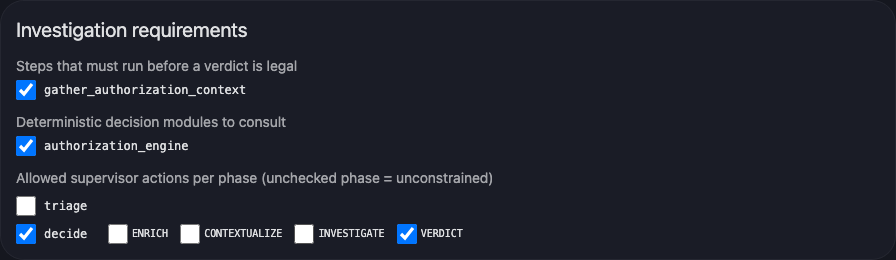
3. Investigation requirements. Require the gather_authorization_context step, declare reliance on the authorization_engine module, and narrow the decide phase to VERDICT only. Note CLOSE is not offered; authored policies cannot grant it.
4. Close sign-off. A committing close on a pci- or phi-classified asset is held for a human.

5. Guardrails. Guardrails run after the safety floor, in order, first match wins. Each condition can be authored as JSON, the sandboxed {"op": [{"var": "field"}, value]} dialect with and/or groups…
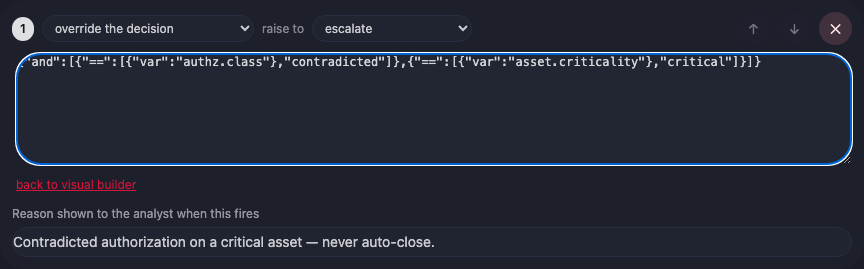
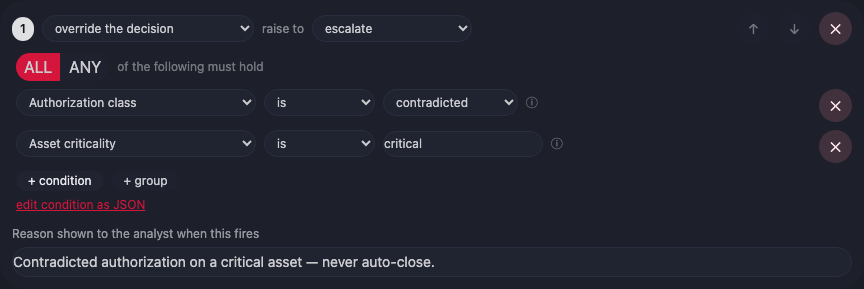
…or in the visual builder, which round-trips with the JSON. This guardrail fires when authorization is contradicted and the asset is critical, and raises the decision to escalate.
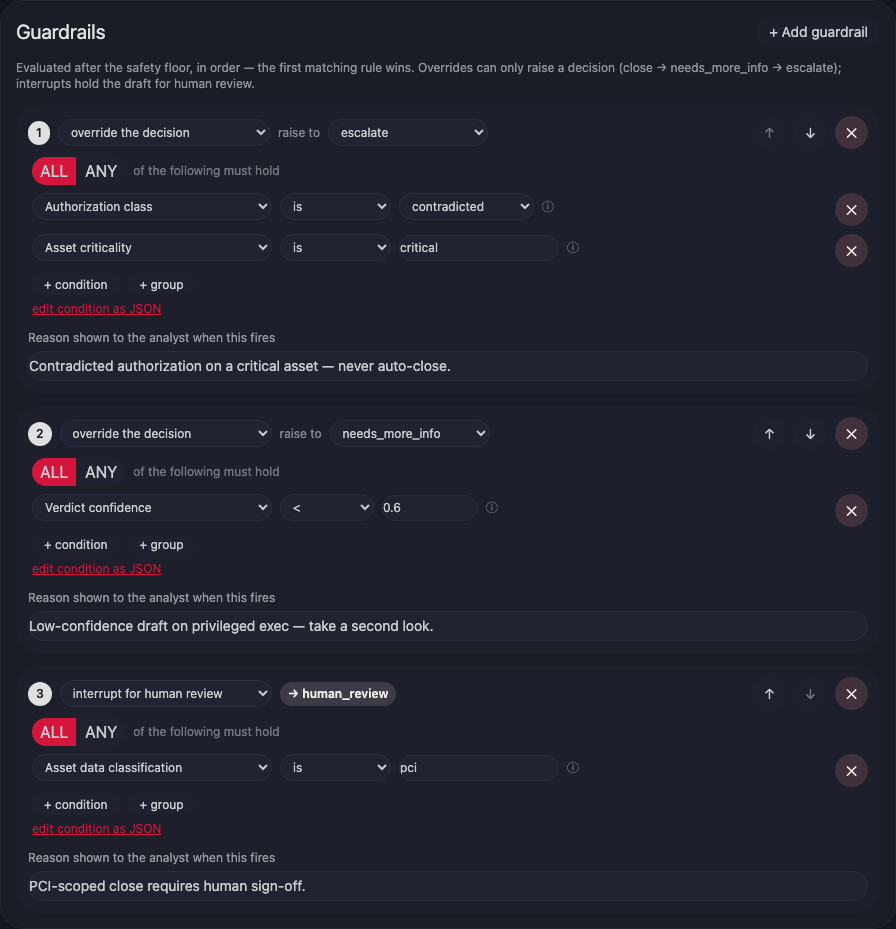
Two more complete the policy: a low-confidence override to needs_more_info, and an interrupt that holds a PCI close for human review. Order matters; the first matching guardrail disposes.
6. Read the flow, then simulate. The right column projects the whole document onto the pipeline: matchers → phases → LLM draft → safety floor (always on) → guardrails → sign-off → commit.
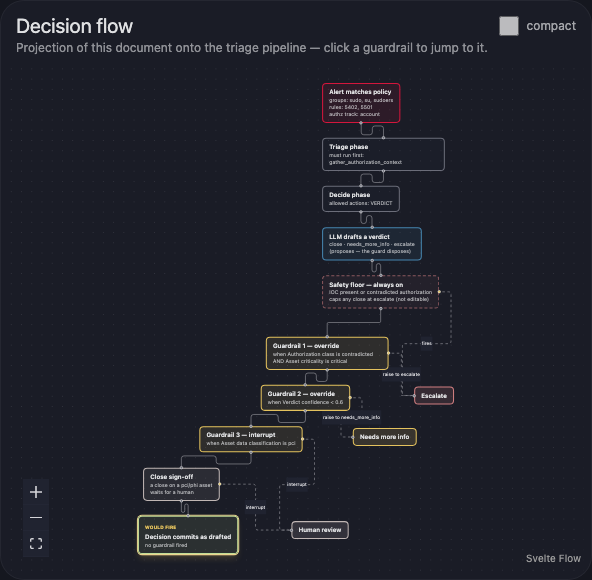
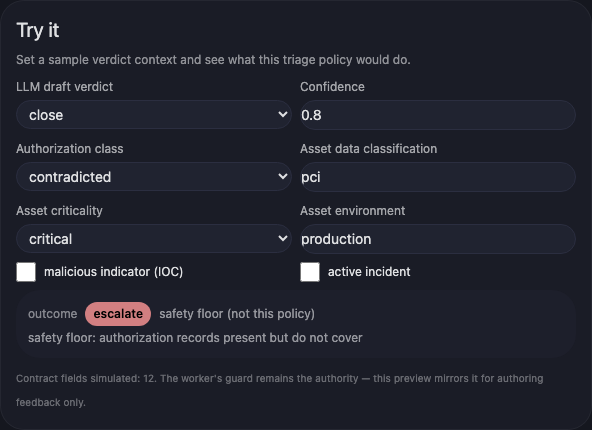
The “Try it” panel previews the guardrail + floor logic the editor can model, a subset of the full worker/server/ingest enforcement path, for authoring feedback. Feed it a contradicted-authorization, critical-asset case and the outcome is escalate, but it comes from the safety floor, not this policy. That is the core invariant made visible: contradicted authorization is a non-overridable floor veto, and the policy's guardrails only raise on top of it.
Create (shadow) saves it. The form and the stored document are the same artifact; “View as JSON” shows exactly what gets persisted.
Validation on save is fail-closed and applies the same rules as file policies plus a few stricter ones: the id must be a slug, referenced steps and decision modules and legal-action phases must be ones the runtime actually knows, CLOSE may not be granted, and the definition is size-capped. An unknown reference is rejected at author time rather than silently ignored at runtime. Every saved revision is kept as append-only history.
Shadow, then activate
An authored policy has four statuses, draft, shadow, active, retired. Shadow evaluation is strongly recommended but not mandatory: a policy can be activated straight from draft.
In shadow, the policy is matched and its guardrails evaluated exactly as an active one would be, and its would-fire decisions are written to the audit trail, but it changes no disposition. This gives you real evidence of what it would do against live traffic before it decides anything.
Activating it (the Activate action on the Triage Policies page) makes it govern. Because the worker is a separate process whose registry loads once at startup, activation cannot just flip a database flag; it materializes the definition into the tenant's worker ConfigMap on the next tenant.reconcile, and the worker rollout is the activation gate: the policy starts governing only when a fresh worker reads it. Editing an active policy keeps it active and re-rolls with the new definition; deactivating returns it to shadow.

Operators who prefer to manage policies as code can still take the git path: write a YAML file into the mounted directory and roll the workers. The same registry loads both authored-and-activated policies and hand-written file policies.
The wiring
Two environment variables carry it:
SOCTALK_TRIAGE_POLICY_DIRon the runs-worker is the directory the registry loads from at startup.SOCTALK_TENANT_TRIAGE_POLICIES_DIRon the controller is the operator-mounted directory the provisioning path reads, validates, and renders into each tenant's chart values as a mounted ConfigMap.
On the chart-provisioned path, policies are tenant chart values (runsWorker.triagePolicies, rendered as the soctalk-triage-policies ConfigMap), and a content change stamps a checksum on the pod template so an edit rolls the worker automatically. The rollout is the activation gate: because the registry loads once per process, a policy only starts governing when a fresh worker reads it.
Every load, skip, and rejection is logged. A file that fails validation for any reason (bad schema, an unknown field, a malformed condition, a priority that would outrank a built-in) is rejected whole and never governs anything, so a bad rollout degrades to "that policy is not active," never to wrong enforcement.